
Showing posts with label Mercedes-Benz. Show all posts
Showing posts with label Mercedes-Benz. Show all posts
Wednesday, April 21, 2010

Mercedes SLK R171 Performance RS Piecha Design has just been released and includes a full body kit that makes the car sportier.
The package is finished by 19 inch and 19/20 inch combination Piecha dp2 Phantom wheels. Also, the car has been lowered by 30 mm – not only for the perfect visual impression, but also to ensure the required wheel cover.
Dubbed the Performance RS, the package features an aerodynamic body kit with new front (€1,590) and rear (€1,355) fascias, aggressive side skirts (€450 each), a rear lip spoiler (€255), and SLR-style mirrors (€690). Wheel choices include 19- (€2,700) and 20-inchers (€2,900), with the latter having a 100mm stainless steel outer rim that "perfectly emphasizes the SLK Roadster's wedge-shape."
Mercedes SLK R171 Performance RS Piecha Design has some other accessories like aerowing on the hood, a module that allows you to raise of close the roof at 60km/h and aluminum insertions.
Source: Piecha Design


Press Release
Mercedes-Benz SLK R171 Performance RS by Piecha Design
Sneak Preview
Stylish tuning is a tradition at Piecha Design. For the current Mercedes Benz SLK R171, the Rottweil tuners present the new performance RS package. It offers a perfect mixture of sportiveness and elegance, as is typical for the company.
The SLK is all grown up now!
The new aerodynamics programme's style is as sportive as it is elegant. It fits seamlessly into the design language of Mercedes-Benz. For the cult Roadster's front, Piecha developed a complete bumper including LED daytime headlights, a wide central spoiler sword and additional brake air channel, integrated fog lamps and lateral double gills. The grille keeps its traditional Mercedes star and is also equipped with polished stainless steel lamellae at the much wider grille bars that reach far to the sides. Rounded side skirts with large air intake channels at the rear end ensure a wedge-shaped looking deeper profile. Optional LED skirt lamps make for gigantic night-light effects. They come on automatically when the vehicle is opened in the dark and indirectly light the area of the side skirts. The striking tear-shaped sports mirrors are attached to two hinged arms and make the SLK look like a true sports car. The re-designed mirrors can be set and heated electrically and folded manually. Piecha Design delivers them completely painted and mounted. For the rear area, Piecha developed a completely new design for the rear skirt. It has a wide grille insert, diffuser and additional under-floor wings. Optionally, the rear skirt is also available with cut-outs for the serial exhaust system or 4-pipe-exhaust systems. An unobtrusive rear spoiler lip integrated flush into the rear lid and reaching all the way to the outer edges provides additional output. The popular Piecha QUADRO exhaust systems were reworked completely and are delivered as a half system from the catalytic converter. It is mounted to the original flange connections without any cutting. The 6-cylinder models are equipped with a flow-optimised X-pipe-adapter and the 4-cylinder version with an adequate connection pipe with V-flange adapter.
The complete aerodynamics programme fits all SLK R171 models incl. facelift and the SLK 55. The only thing to be observed is whether or not the vehicle is equipped with a parktronic (PDC), and, if so, if it is pre- or post-Facelift 2008.
Matching wheel/tyre combinations are 19 inch and 19/20 inch combination Piecha dp2 Phantom wheels. The 19 inch ones are ideal from a driving-dynamics point of view, at the front in 8.5 x 19 with 225/35 ZR 19 and at the rear in 9.5 x 19 with 255/30 ZR 19 tyres. An optical treat, however, is offered by using 8.5 x 19 with 225/35 ZR 19 tyres in front and combining them with 9.5 x 20 drop-centre rims at the rear axis and 265/25 ZR20 tyres. A special drop-centre rim version with a gigantic 100 mm stainless steel outer rim was developed particularly for the 9.5 x 20 rims. This version perfectly emphasises the SLK Roadster's wedge-shape and fits under the serial body with only little reworking. A basic prerequisite for this, however, is that the car is lowered by about 30 mm - not only for the perfect visual impression, but also to ensure the required wheel cover.
To top everything off, the SLK R171 Performance RS programme must of course include popular accessories such as the aerowings for the hood, the comfort vario roof module with "one touch function" and the possibility of opening or closing the roof at up to 60 km/h, the "must have" power converter for perceptibly improved acceleration and a more dynamic reaction and small attributes such as door pins with high-quality aluminium. The real glass wind deflector with perforated inserts for the roll-bar are necessities as well, since it not only enables a clear view to the rear but also reduces air vortices in the interior to a minimum and offers an optical contribution to the overall package.
Prices
Front skirt complete as indicated 1,590.00 Euros
With PDC 1,690.00 Euros
Rear skirt complete as indicated 1,355.00 Euros
With PDC 1,455.00 Euros
Side skirt with grille insert per side 450.00 Euros
Surcharge for LED skirt illumination 298.00 Euros (both sides)
Rear spoiler lip 255.00 Euros
Glass wind deflector set with bar inserts 398.00 Euros
Painted sports mirrors Pair 690.00 Euros
Complete wheel set dp2 Phantom
8.5x19 with 225/35 ZR19 front
9.5x20 with 265/25 ZR20 rear 2,900.00 Euros
Alternative
Rear 9.5 x 19 with 255/30 ZR19 2,700.00 Euros
QUADRO half system for SLK 200 1,190.00 Euros
QUADRO half system for SLK 280-350 1,285.00 Euros
Tuesday, April 20, 2010
Well now this car sees actual form as a concept and it’s called the Mercedes-Benz Shooting Break Concept.
The car that Mercedes unveiled today shows that there still may be hope for the estate buyer just as the CLS revived the estate as a good looking car. The Stuttgart automaker has announced that this concept will make its debut at the Beijing Motor Show, sometime later this week.
This model brings together features from the F800 Concept, from the Mercedes SLS AMG, from the FASCINATION Concept car and is hailed by Mercedes as some future insight in the design possibilities of the Coupe Concept.
The bonnet of this concept covers up a 3.5 liter V6 engine that develops 306 horsepower and 273 lb-ft of torque that features BlueEFFICIENCY technology in order to obtain better fuel consumption. Some other interesting technology that can be found on this concept is the dynamic full LED headlamps that are a world premiere on any car.
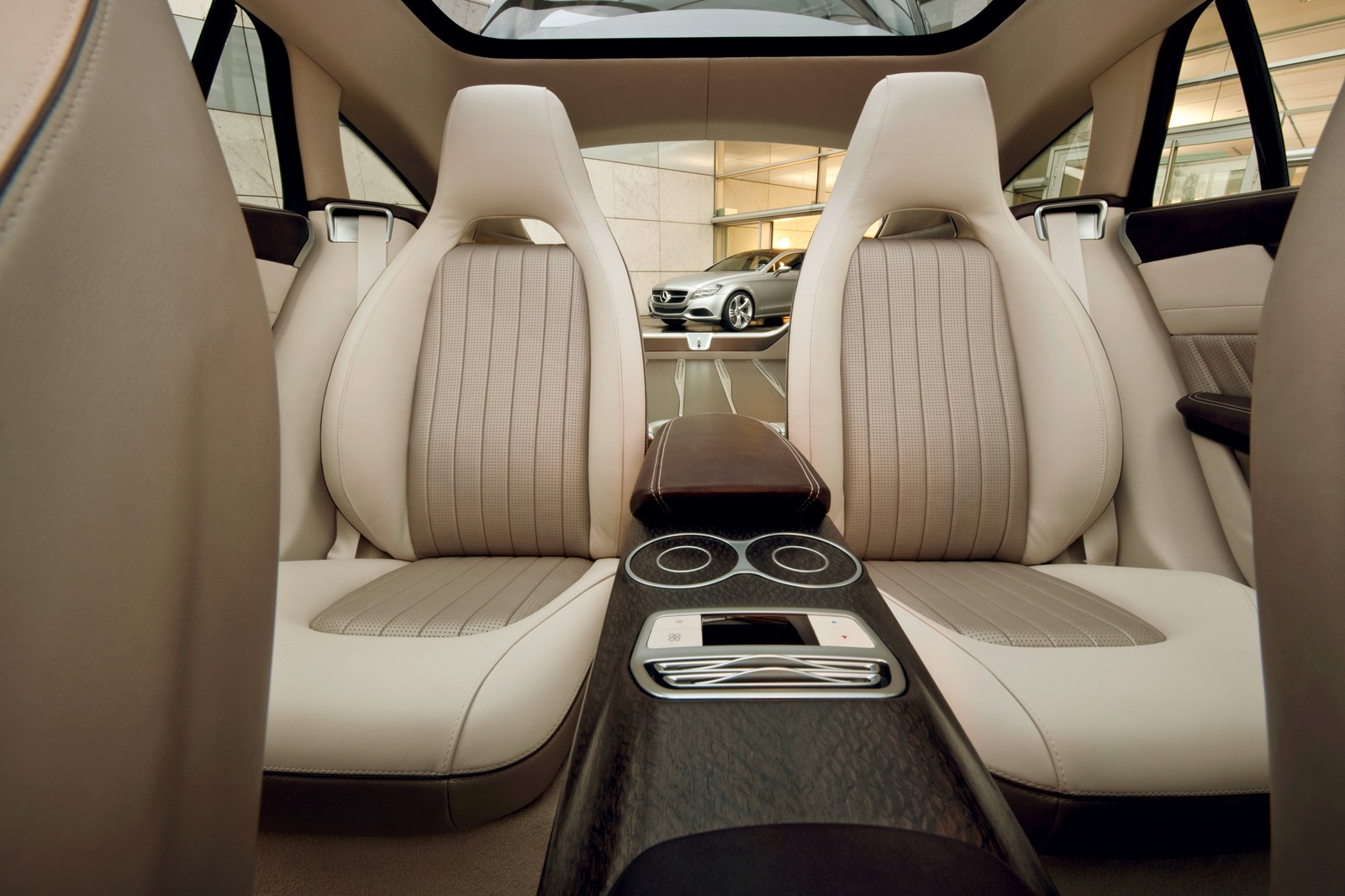
Inside, the car makes good use of contrasting cream and brown leather, though a third leather shade needlessly creates a tri-color scheme. The use of the cream tone as the dominant color that carries into the headliner works to make the concept feel more spacious and comfortable. This is further accentuated by the large glass roof that extends over the heads of the rear passengers. Behind the rear seats are stylish storage units meant to fit items like a laptop or tool kit, with a drawback that they may be hard to reach. A flat wooden floor in back will make sliding luggage or golf clubs in and out of the car a bit easier.
Should this concept hit production, it will be the best competitor for the BMW 5 Series GT and i have to admit, as far as looks are concerned the Mercedes-Benz Shooting Break Concept is already winning.


Press Release
THE SHOOTING BREAK CONCEPT CAR: TAKING THE COUPÉ DESIGN TO NEW HEIGHTS
World premiere at "Auto China 2010"
* Innovation four-door Coupé with sloping tail end
* World premiere: dynamic full LED headlamps
* Forerunner: new V6 petrol engine with direct injection
In October 2004 Mercedes-Benz established a new market segment with the four-door Coupé CLS. In September 2008, the brand revealed a fresh and exciting interpretation of the emotionally-appealing Coupé-based design in the form of the FASCINATION concept car. Now making its premiere at Auto China 2010 is the Shooting Break concept car - a further insight by Mercedes designers into the possible future development of the Coupé concept. The Shooting Break concept car also represents a clear indication of the further emotional appeal of the Mercedes design idiom.
Wide and flat, with a long bonnet and a roof which continues through to the rear: the Shooting Break concept car features some astonishing proportions which at the same time are clearly reminiscent of another design icon - the CLS. The design of the front is completely new, but makes use of elements which are mindful of the SLS AMG super sports car: the radiator grille, with the large star and eye-catching, bionic slats, is not integrated into the bonnet but has been designed separately in the form of a "soft nose". The grille is flanked on each side by full LED headlamps, which for the first time feature LED technology for all of the usual dynamic light functions. The side profile is given a touch of dynamism thanks to the high, exaggerated beltline sweeping towards the rear, and the dramatic character line which is supported by the powerful-looking rear wheel arches. The coupé-like side view is also emphasised with a low window design which also highlights the greenhouse with polished aluminium trim.
The interior is dominated by natural wood and leather materials. One eye-catching feature is the large full-length centre console. It highlights the four- seat layout as well as the high levels of comfort afforded by the Shooting Break concept car. The wooden floor of the luggage compartment reflects the true interpretation of this area of the vehicle, where the dark-stained silky oak contrasts against inlaid aluminium protective loading strips.
The Shooting Break concept car is driven by the forerunner to the forthcoming new V-engine generation from Mercedes-Benz. The V6 benefits from a 60° cylinder angle and a displacement of 3.5 litres, and is characterised by direct injection featuring a control system which enables lean-burn operation. The six-cylinder engine produces 225 kW (306 hp) with a maximum torque of 370 Nm and in line with the BlueEFFICIENCY criteria of Mercedes-Benz also sets new standards among the competition in terms of fuel consumption.
The exterior: stylish and sporty
The proportions are clearly those of a coupé: the long bonnet, narrow-look windows with frameless side windows, and dynamic roof sloping back towards the rear create a basic stance with which it looks ready for the off. It is only when taking a second look that it becomes clear that the Shooting Break concept car actually has four doors and an estate rear. As such, this study in design reveals its philosophical links with the four-door CLS Coupé, a car which has established a new market segment since 2004 and today is already seen as a design icon which is likely to occupy a very special place in the history of the motor car. The Shooting Break concept car may well be looked back on at some point as having played a similar role, taking ideas from the FASCINATION concept car premiered in 2008 and projecting them into the future.
"The Shooting Break concept car is based on the great tradition of a stylish, cultivated sportiness which has always characterised the great Mercedes Coupés, and it takes this unique legacy an exciting step further," explains Professor Gorden Wagener, chief designer at Mercedes-Benz. "At the same time it points the way towards the future design idiom of Mercedes-Benz."
The vocabulary of the design idiom includes the contrasting play between lines and exaggerated areas, which combine to create an animated area of interaction. The expressive design of the front immediately catches the eye, using elements which are mindful of the SLS AMG super sports car, and with a radiator grille which for the first time has been designed as a "soft nose" and is not integrated into the bonnet. This contributes to better pedestrian protection and at the same time also helps to improve the focus on the long, sporty bonnet. The grille is dominated by the large central star, highlighting its relationship to the other Coupés of the Mercedes brand. It is supported by bionic, curved grille slats. Their curved design is reflected in the expressive look of the front apron and air intakes.
Particularly eye-catching are the full LED headlamps, which for the first time offer all of the regular dynamic light functions using LED technology. Inside they are divided into three arrow-shaped layers from top to bottom: the upper layer contains an LED indicator, beneath which is a striking LED side light offering LED low beam functions. The side light can also be seen when the dipped beam function is switched on, thereby creating a novel and separate night-time design and distinctive look. The lowest level of the headlamp houses the main beam and nightview functions. A total of 71 LEDs not only provide an unmistakable appearance, but also a significantly enhanced view of the road compared with previous systems.
The side profile of the Shooting Break concept car is dominated by the low, frameless side windows, the coupé-like shape of which is further highlighted with the incorporation of a polished aluminium frame along the body. Thanks to the positioning of the outside mirrors on the beltline, the side line is emphasised and all-round visibility has been improved in the region of the A-pillars. The side windows are supported on a high beltline, which slopes towards the rear in a fresh interpretation of the classic "dropping line" of iconic Mercedes Coupés. An additional exciting touch has been made with the prominent, muscular hip points which forcefully support the side line. This interaction gives the impression of a sprinter, poised in the starting blocks, ready to release an explosive forward surge of energy. The roof follows through to the rear and also drops away in typical coupé fashion. Another special feature is the recessed, filigree door handles, which emerge on being touched with the aid of sensors to allow access to the interior.
The side view is rounded off with wide wrap-around tail lights featuring LED technology. As such they form a linking element to the low, steeply-angled estate car rear end with top-hinged tailgate. The shape is emphasised by the broad shoulder line, which is clearly visible from behind and supports the lowered-look greenhouse. The twin pipe exhaust system, with two polished exhaust covers, is integrated into the rear bumper, which features an elegantly curved wing.
Also contributing to the special appearance of the Shooting Break concept car is the exceptional paint finish. A satin-finish clear coat has been used, which gives the vehicle's allanite grey magno colour a mysterious glint and also further brings out the Coupé's exquisite lines.
The sporty look of the Shooting Break concept car is complemented with large 20-inch sterling silver wheels, featuring a special bionically arranged five-spoke filigree design. They allow a glimpse of the large brake discs behind. The front wheels are fitted with 255/30 ZR 20 tyres, while the rear of this exceptional vehicle sits on 285/25 ZR 20 tyres.
The interior: design makes quality noticeable; high-quality materials, hand-crafted perfection
A large panoramic glass sunroof provides a glimpse into the high-quality, perfectly hand-crafted interior of the Shooting Break concept car, where natural materials such as wood and leather dominate. Wood is used on the trim elements and door pulls, the instrument panel and centre console, and primarily on the luggage compartment floor in the rear. When it came to choosing the wood, the interior designers opted for silky oak on account of its unusual, lens-shaped texture. The wooden floor in the luggage compartment has inlaid aluminium protective loading strips, and is reminiscent of finishes normally seen in yacht building.
Four saddle bags along the sides of the luggage compartment are useful for storing small tools. They are finished in leather, a material which has been used extensively throughout the Shooting Break concept car: in fact, almost ten square metres of leather have been incorporated into the interior. Light sections of porcelain-coloured nappa leather form an attractive contrast to the dark-brown natural-coloured aniline leather and perforated metallic-silver finish seat cushions and door centre panels. Extensive double-lapped stitching and discerning colour-coordinated upholstery seat piping reflect the hand-crafted perfection and attention to detail, as does the tuck stitching on the instrument panel, door sill covers and seat backrests, all of which highlights the contours of the components extremely well.
Perfection and attention to detail also apply to the trim elements. While on the exterior they are polished to a high-sheen finish, in the interior they feature a matt finish. A total of seven manual processes are necessary - from grinding to polishing - to transform the components, which are milled completely from aluminium, into their final decorative form. The matt finish of the interior trim has also served as inspiration for the metallic-silver leather on the seats, door centre panels and bags in the luggage compartment. The deep-pile carpet in the footwell - finished in porcelain colour - is a luxurious material used by Maybach-Manufaktur. The light-coloured roof liner made of silk cloth adds the finishing touch to the impression of comfortable elegance in the interior.
The Shooting Break concept car is clearly a four-seater. The four identically shaped leather seats have a touch of the sports car about them thanks to their integrated head restraints. Openings in the upper area of the backrests make it possible to see through the seats. A large full-length wood console on the transmission tunnel provides a visual divide between driver and front passenger and at the same time indulges the occupants with two large leather-covered armrests. It also houses two cup holders as well as controls for the rear-compartment air conditioning. The centre console is finished off at the rear with inlaid work: curved Mercedes lettering which harks back to the style of the 1920s. The striking cursive-script lettering is also repeated on the front door sills.
Since the central screen has been integrated into the upper part of the instrument panel, the cockpit has a "wrap-around" effect. The elegant verve and bionic details of the exterior are captured, among other things, in the dynamic wave-design air vents in the instrument panel. An analogue clock sits in the centre. The instrument cluster comprises three tubes for dial-type gauges as well as a colour display for service indications.
The headlamps: exciting LED technology offering full functionality
The Shooting Break concept car has dynamic full LED headlamps, which combine the exciting daylight colour impression of LED technology with the performance, functionality and energy efficiency of today's bi-xenon light generation. The new light system, due to make its debut in series production this year, features the Intelligent Light System which has already been tried and tested in Mercedes models with bi-xenon headlamps. Its five light functions - country lights, motorway lights, enhanced fog lights, active curve lights and cornering lights -have been specifically designed for typical driving or weather conditions.
The light specialists at Mercedes-Benz have also been able to combine LED technology with the innovative Adaptive Highbeam Assist for the first time, leading to a completely new level of safety at night.
The engine: enhanced performance, enhanced efficiency
The Shooting Break concept car is driven by the forerunner to the forthcoming new V-engine generation from Mercedes-Benz. The special features of the spray-guided direct injection engine include the latest generation of piezo-electric injection valves which enable multiple injections. Better lean operation is possible thanks to load monitoring of the pressure information. Even the operation of the ancillary components has been made efficient and there is also a start/stop function. The V6 with a 60° cylinder angle and displacement of 3.5 litres produces 225 kW (306 hp) with a maximum torque of 370 Nm.
It's all in a name: the origins of the name "Shooting Break"
Break, or the homonym Brake, was the name once given to carriages used to "break" in wild horses and also to restrict (or "brake") their urge to move, so that they could be put to use as work horses. Since the carts could easily be broken as part of this process, people tended not to use ones which they may have urgently needed for other purposes. Where necessary, "Brakes" were often fitted out with variable bodies, which were only really used to carry along anything that may have been necessary for the hunt, for example. Any such vehicle which was used when going out shooting was called a Shooting Brake or Shooting Break. In the 1960s and 1970s motorised Shooting Breaks were popular in Great Britain - exclusive cross-over vehicles, which combined the luxuriousness of a coupé with the luggage space of an estate.
Wednesday, March 31, 2010

Mercedes-Benz introduced a new race car during the New York Auto Show earlier today. The Mercedes-Benz SLS AMG GT3 will be used in competition beginning in 2011.
The 2011 Mercedes SLS AMG GT3 is powered by the AMG 6.3-litre V8 front-mid engine with dry sump lubrication coupled with a sequential six-speed racing transmission steering wheel shift paddles. The 2011 Mercedes SLS AMG GT3 also comes with an multi-disc locking differential integrated in the
transmission. The engine and the transmission of the 2011 Mercedes SLS AMG GT3 are connected via a torque tube within which a carbon-fiber shaft rotates at the engine speed, as in the roadgoing version.
The SLS AMG GT3 features a new new front apron with a splitter, the bonnet with central cooling air vent, wider front and rear wings, sideskirts with cooling ducts for the rear brakes, a rear diffuser and the adjustable rear aerofoil.
That light-weight body is made entirely of carbon fiber, with impressive new aerodynamics including a massive front splitter, rear diffuser and enormous rear spoiler. Compared to the road car, the GT3’s bodywork is two inches wider, enough to accommodate some massive center locking 18×12-inch front and 18×13-inch rear wheels with racing slicks. Inside those wheels is a special composite AMG race braking system with six-piston front calipers and four-piston rear calipers.
The 2011 Mercedes SLS AMG GT3 price was not announced yet, but Daimler mentioned that sales will start in autmun 2010.


Press Release
Automobile fascination paired with spectacular race car design - that is the new Mercedes-Benz SLS AMG GT3. The racing version of the SLS AMG has been conceived as a customer sport vehicle for participation in race series based on FIA GT3 regulations. Meticulous lightweight construction and optimized chassis, brakes and aerodynamics deliver uncompromising dynamics. The extra special SLS AMG will make its race track debut in 2011.
The clean design and breathtaking form of the SLS AMG have been effectively accentuated by targeted modifications to the bodyshell. The new components, made largely from lightweight carbon fiber offer a clear indication of extraordinary race track performance and extensive aerodynamic development work.
From the front, the GT3 race car boasts a new front skirt with enlarged air intakes. The wide opening beneath the characteristic radiator grille bearing the large Mercedes star and the wing-shaped horizontal fins supplies air to the engine oil cooler and brake discs. The same function is served by the two intakes below the vertical bi-xenon headlamps. Downforce on the front axle is provided courtesy of four externally mounted side flics, as well as a carbon front splitter; it runs directly into the smooth underbody panel, which connects to the rear diffuser.
The hood features a central opening for the extraction of heat from the engine, while side openings in the front fenders facilitate air flow through the wheel arches. Weight optimization measures include the application of extremely lightweight polycarbonate for the side and rear windows and, if desired, for the front windshield as well.
The fenders have been widened front and rear to accommodate the large racing tires. With a breadth of 78.3 inches, the GT3 bodyshell is a good 2 inches wider than the series production SLS AMG. The new sills feature openings for cooling the rear brakes, with the smooth underbody visible along the underside of the sills. The B-pillar houses the standardized fuel tank adapter for the rapid refueling system. The 31.7 gallon fuel tank is located centrally behind the driver.
Wide rear carbon spoiler
The rear view of the SLS AMG GT3 is dominated by its imposing width. Above the rear hatch sits a wide carbon fiber spoiler; it is extensively adjustable and facilitates perfect setup to suit individual race track characteristics. The new rear skirt accommodates two openings for extracting air from the rear wheel arches. A further visual highlight is the rear carbon fiber diffuser; it rises smoothly from the rear axle area as a continuation of the smooth underbody, its form adding to the downforce. The overall aerodynamic concept of the SLS AMG GT3 was analyzed and defined through extensive wind tunnel and race track testing.
The black exhaust end pipes deliver a fascinating and, at the same time, characteristic AMG eight-cylinder sound. The regulation rain lamp is integrated into the rear hatch - it must be switched on by the driver in poor weather conditions.
Close to series production AMG 6.3 liter V8 engine
As defined in the FIA GT3 regulations, the AMG 6.3 liter V8 engine is virtually identical to that of the series production vehicle. Thanks to its low weight, the acceleration figures for the GT3 - 3.7 seconds for the sprint from 0 to 60 mph - are considerably below the already excellent figures for the series production vehicle. Depending on gear ratio, the top speed is more than 186 mph.
The AMG 6.3 liter V8 engine uses dry sump lubrication in the racing vehicle, too. The application of a suction and pressure pump, as well as an external oil tank means that the conventional oil sump can be omitted. This technology ensures reliable lubrication of the engine under high lateral acceleration, of the kind usually experienced on the race track.
Dry sump lubrication also facilitates a low mounting position for the V8 power unit - one of the key technological highlights of the SLS AMG. The solution - installing the eight-cylinder as low as possible and as a front mid engine behind the front axle, combined with a transaxle transmission layout - results in excellent weight distribution.
Six-speed racing transmission with sequential shift
In contrast to the series production vehicle, the SLS AMG GT3 is equipped with a six-speed racing transmission with sequential shift. Thanks to its compact construction, the race-tested transmission offers considerable packaging benefits - ultimately, the GT3 version has less ground clearance than the series production vehicle. The driver shifts gear using two shift paddles on the steering wheel. The transmission is mounted directly on the rear axle and connected to the V8 engine via a torque tube, which has a very high degree of flexural and torsional stiffness. This delivers considerable benefits when it comes to dynamics, as this sophisticated solution enables the entire driveline to be laid out with significantly less play. Alongside the traction control, a multi-plate locking differential integrated into the transmission delivers outstanding acceleration characteristics. Inside the torque tube, a drive shaft rotates at engine speed. As in the series production model, and in the Mercedes-Benz C-Class DTM touring car, the shaft is made from carbon fiber.
With its long wheelbase, low center of gravity and wide track, the SLS AMG vehicle concept was predestined for the race track - its strengths include precise turn-in characteristics, first-class agility, low inertia under sudden changes of direction and a high cornering limit.
It required only minimal modification for perfect race track performance. The lightweight aluminum chassis with double wishbone suspension at all four corners has modified kinematics to take into account the lower vehicle height. The array of adjustability options facilitates optimal modification to suit individual race track characteristics and varying weather conditions. As well as the ability to vary the spring and damper setup, there is also the freedom to adjust track and camber, vehicle height and the stabilizers on the front and rear axles.
Like the series production SLS AMG, the GT3 version is also equipped with rack and pinion steering with speed-dependent power assistance. The more direct input ratio facilitates even greater handling agility on the race track.
AMG race braking system using composite technology
Shortest stopping distances, highest stability and optimal control are guaranteed by the AMG race braking system. All four corners feature brake discs in motorsport-tested composite technology. Gray cast iron axial and radial floating discs are fixed to an aluminum hat via stainless steel composite elements. This sophisticated technology enables perfect heat dissipation and thus reliable stability. The SLS AMG GT3 is also equipped with precisely calculated cooling channels - openings in the front skirt and ahead of the rear wheels direct cool airflow over the brake discs. All four brake discs are ventilated, slotted and drilled. Six-pot fixed calipers on the front axle and four-pot fixed calipers at the rear, finished in anthracite with the AMG logo in white, provide plenty of brake pad surface. An anti-lock brake system with special race track settings is fitted as standard. Due to space restrictions, the AMG high-performance ceramic composite brake system, available as an option on the series production vehicle, is not compatible with the 18-inch wheels prescribed by FIA regulations.
The AMG center-locking alloy wheels - 12x18 inches front and 13x18 inches rear - are fitted with racing tires in formats 11.3 x 26.9 inches (front) and 12.4 x 27.9 inches (rear). Depending on the application, the tires are available as profile-free slicks, intermediates or wet weather tires. The classic multi-spoke design aids ventilation of the braking system. Fast pit stops and wheels changes are ensured by the pneumatic lift system integrated into the underbody. Four pneumatic rams raise the GT3 race car by around 7.5 inches, enabling the pit crew to change the racing tires in double quick time.
Interior with racing bucket seat and race steering wheel
On opening the gullwing doors, the SLS AMG GT3 displays a functional interior with a distinctly race car feel. The driver sits in a racing bucket seat fitted with a six-point harness and the HANS system (Head and Neck Support) that fixes the helmet in place in the event of an accident, thus minimizing the risk of injury. Additional safety comes courtesy of the steel roll cage, which also serves to further stiffen the aluminum spaceframe.
A steering wheel with a diameter of 13 inches facilitates perfect vehicle control. Because it is open at the top, the driver always has a perfect view of the central display, which provides all relevant information such as road speed, engine speed, operating temperatures, lap times and gear selection. The steering wheel is fitted with a quick-release mechanism that makes entering and exiting the vehicle considerably easier. The switches on the steering wheel hub enable the driver to activate additional functions such as the pit radio, headlamp flasher and the drink supply. Further operating elements are mounted on the center console and include the start/stop function for the AMG V8 engine, the traction control, reverse gear and - just in case - the integrated fire extinguisher. The control for adjusting brake balance is located on the torque tube tunnel.
The close relationship between the GT3 and its series production sibling is demonstrated by the instrument cluster, with its powerfully taut wing profile providing visual breadth. Integrated into the dash are the highly distinctive air vents galvanized in "Silver Shadow" and with adjustable cross-shaped nozzles - their form evocative of a jet engine.
Deliveries of customer vehicles to start early 2011
The new SLS AMG GT3 has been developed in accordance with FIA GT3 regulations and is entitled to participate in all GT3 race series - including the popular 24-hour races in Spa-Francorchamps, Belgium, and on the Nürburgring in Germany. Interested customers can order the vehicle starting in autumn 2010, with delivery scheduled prior to the start of the 2011 racing season. Homologation will be completed in March 2011.
Saturday, March 27, 2010

Daimler has released today the 2010 Mercedes E Class Cabrio scale model which is available in three sizes: 1:87, 1:43 and 1:18. The 2010 Mercedes E Class Cabrio scale model is available in various color combinations and will become available in showrooms from 27 March.
The 1:87 models are manufactured by Busch in Viernheim and come in non-metallic black, iridium silver metallic and calcite white and are priced at €15.90.
The 1:43 models are produced by Schuco of Fürth and have a price of €28. They come in a choice of stannite grey, fire opal or indigolite blue.
The bigger 1:18 model is priced from 59.90 EUR and features opening doors, trunk and hood. The 1:18 2010 Mercedes E Class Cabrio scale model is made by Norev.
via:zercustoms


Press release
The new Mercedes-Benz E-Class Cabriolet will be available for delivery as of 27 March. To tie in with the launch, the corresponding miniatures will also go on show at Mercedes dealerships on a scale of 1:87, 1:43 and 1:18.
Does a black/alpaca grey interior provide the most attractive contrast to the iridium silver exterior? Or is stannite grey a better choice for the new Mercedes, combined with a mocha brown/almond beige interior? It’s not only customers buying a new car who are spoilt for choice when it comes to the E-Class Cabriolet. The high-quality miniature versions of the open-top four-seater also offer model car enthusiasts a choice between various individual colour combinations featuring original paint finishes for Mercedes-Benz vehicles. All models will be available exclusively from authorised Mercedes dealers as of 27 March, with toy shops following suit some months later.
The 1:87 models are manufactured by Busch in Viernheim and come in non-metallic black, iridium silver metallic and calcite white. The recommended retail price is €15.90. The 1:43 models of the open-top four-seater are produced by Schuco of Fürth (€28). These models come in a choice of stannite grey, fire opal or indigolite blue. The 1:18 models are manufactured by Norev. The interior is faithfully reproduced on all models. On the 1:18 model the doors can be opened to provide a closer look inside. Both the bonnet and the luggage compartment can also be opened up on this model. The interior and the luggage compartment are flock-coated throughout, fully in keeping with the original. This miniature is available for €59.90 in obsidian black, fire opal and iridium silver.
To enable the original and the miniature to grace the showroom at the same time, Mercedes-Benz cooperates closely with selected dependable suppliers from the model-car industry. Despite recourse to state-of-the-art computer design
technology, it still takes around a year to develop a high-quality miniature. This means that when the model-car specialists began their work, the original E-Class Cabriolet was still strictly confidential. The selected model car suppliers are provided with design data in advance, to enable the miniatures to be produced according to the same quality standards which apply to the full-scale vehicle.
Wednesday, March 24, 2010
Mercedes SLR Stirling Moss Edition and Hakkinen Shooting Commercial in Barcelona
0 comments Posted by Dono at 1:19 AM
Somebody at Daimler must have been a big fan of recent photos showing the Audi A1 S-line in Barcelona's Raval district. The company has been working on a new video shoot for the Mercedes-Benz SLR Stirling Moss Edition a few kilometers away from the A1 location, and close to scenes used in a video of the Alfa Romeo Giulietta.
The SLR Stirling Moss Edition was the last version that became the SLR McLaren, and was filed in 2009. Is inspired by the 300 SLR that Stirling Moss took the victory in the Mille Miglia in 1955, along with journalist Denis Jenkinson, ie, which has no windscreen or roof or anything like it.
With a weight of 200 kilos less than the conventional SLR, and a little more power (650 horses on the original 617), accelerates from 0 to 100 in 3.5 seconds and can take the 350 km / h. S'en only 75 produced, which were offered only to customers who already have a SLR to your garage. The price? Well 750.000 .- €. Almost nothing.
via:worldcarfans


Subscribe to:
Posts (Atom)


